
Using Trimmy
Private rules
How a PRIVATE rule keeps your trigger price off the chain, and the exact trust you take on in exchange.
Working with an agent? Every page here has a markdown twin, the whole site is one file at llms-full.txt, and trimmy-mcp lets it read live rules and compose a payment it cannot send.
Testnet. Trimmy runs on Flare Coston2. Nothing described here has run on Flare mainnet, and no page on this site describes real money.
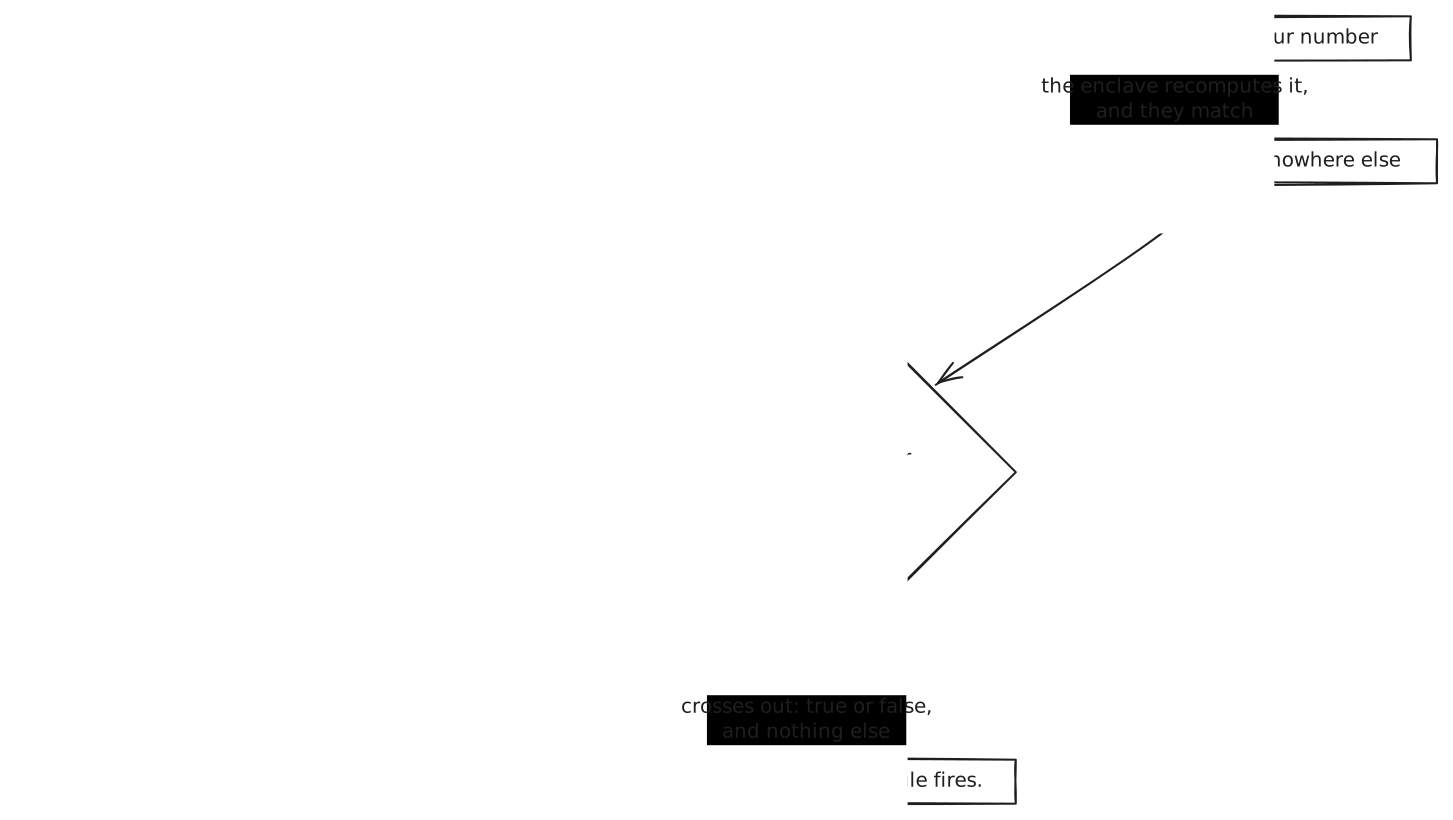
The number you do not want to publish
You want a rule that sells if XRP falls to a certain price. On a PRICE_BELOW rule that price is
stored as triggerValue, where anyone can read it. It announces the exact price at which a large,
price-insensitive sell will arrive. Centralised venues do not publish their stop books, and this is
the reason.
A PRIVATE rule is the same rule with the number withheld. Everything else stays public: the
amount, the venue, the token pair, the budget, the expiry. The other three triggers are in
Rule types.
What the chain holds instead
A commitment: a hash of your number that proves you fixed it in advance without revealing it. The
rule stores triggerValue = 0, and the trigger contract stores
keccak256(threshold ‖ 0x1f ‖ salt ‖ 0x1f ‖ direction).
The salt is a random string of at least 16 characters, and it is what makes the commitment worth anything: stop prices sit in a small, guessable range, so without one somebody could hash candidates until one matched.
Where your number actually lives
In the memory of one enclave: a Google Confidential Space virtual machine on AMD SEV hardware. You encrypt the threshold to that enclave's public key before it goes anywhere, so what crosses the chain is ciphertext and the only plaintext copy is inside the machine.
Nothing is written to disk. Enclave memory is volatile, so a restart loses every secret and those rules stop firing until you provision again. A store that survived a restart would be one we could read.
What the enclave answers
When a keeper wants to run your rule, the contract asks the enclave one question. The price in it is read from FTSO by the contract itself and is never supplied by the caller. An earlier version took it as an argument, which let a stranger fire another user's rule at an invented price and recover the secret in about twenty queries. That is fixed, with regression tests.
A real reply:
{"ruleId":0,"fire":true,"commitment":"0xeca87739…","nonce":0,"issuedAt":1786297877}. A yes or a
no, the commitment it refers to, a replay-proof nonce, and the time it was formed. No threshold, no
margin, no distance from firing. A distance would leak the number across repeated questions, so the
enclave never computes one. The contract refuses a verdict older than 90 seconds.
| What an observer sees | Public |
|---|---|
| The rule, its amount, venue, pair, budget and expiry | yes |
| The commitment, the verdict, and the trade after it | yes |
| Your threshold, and how close the price got | no |
This hides the trigger, not the history. On Coston2, rule 0 was armed with a threshold of
1100000, provisioned, evaluated and executed, and that value appears nowhere on chain.
What you are trusting
The trust model for PRIVATE is strictly weaker than the other three triggers. All of it:
- One enclave, not a quorum. We run it.
- Its operator can censor you by declining to act. A private rule needs a fresh signed verdict,
so if we stop running the extension, your rule stops firing.
PRICE_BELOW,PRICE_ABOVEandSCHEDULEare permissionless: anyone can execute them, and every bound is re-derived on chain. - There is no on-chain heartbeat. A silent enclave and a price that never reached your number look identical from outside. It is not built.
- You are trusting AMD SEV and Google's attestation, which we did not build. The contract
accepts a verdict only from a live machine registered to this extension and reporting
GCP_AMD_SEV. It rejectsTEST_PLATFORM, which matters: 254 of 268 active TEE machines on Coston2 are simulated, hold the same live status on chain as real hardware, and share one code hash constant, so a verdict from one proves nothing about what code ran. - The full code hash is not published, only its first four bytes,
0xe9ab7410…. Until all 32 are out, nobody outside can rebuild the image and check the running code against it.
A dishonest verdict is bounded: it only permits the rule to run. Execution re-derives the price
from FTSO, applies the oracle floor and the slippage cap, respects the budget and the expiry, and
pays proceeds to your own account. The worst a lying enclave achieves is firing your rule early, at
a price inside the floor. Cancelling calls forget, which asks the enclave to drop your secret, and
you are trusting that it did.
Arming one today
Provisioning is a command-line step, on Coston2 only (where Trimmy runs today).
go run ./cmd/trimmy-private \
  -rule 0 -threshold 1100000 -direction 0 -account 0x07a76b5c…
A private execution costs 517,962 gas against 383,451 for the plain path.
If software is composing the rule
A Trimmy rule is a bounded mandate an agent can compose but cannot exceed: an exact allowance rather
than an unlimited one, one verb, one venue, one token pair fixed at deploy time, a hard budget, an
expiry, and an epoch counter that cancels everything at once. A compromised agent extracts nothing,
because PersonalAccount.executeUserOp is onlyController and the agent is not the controller.
A private rule adds one thing: the software composing it never learns your price. It handles a commitment and a ciphertext, and neither reveals the number, so it can pick the venue, size and schedule without knowing when your rule fires. That holds only if you do the encrypting.
/docs/private-rules/index.md